Entity diagrams
An entity is a box that lists its attributes under its name, and a relationship ends in how many. Held to the same measure, and to the rows each box lists and what each link ends in.
Declared with erDiagram. Of 48 features Mermaid documents for an entity diagram, 38 drawn as written, 10 drawn less something. See all 48 drawn both ways, or draw one yourself.
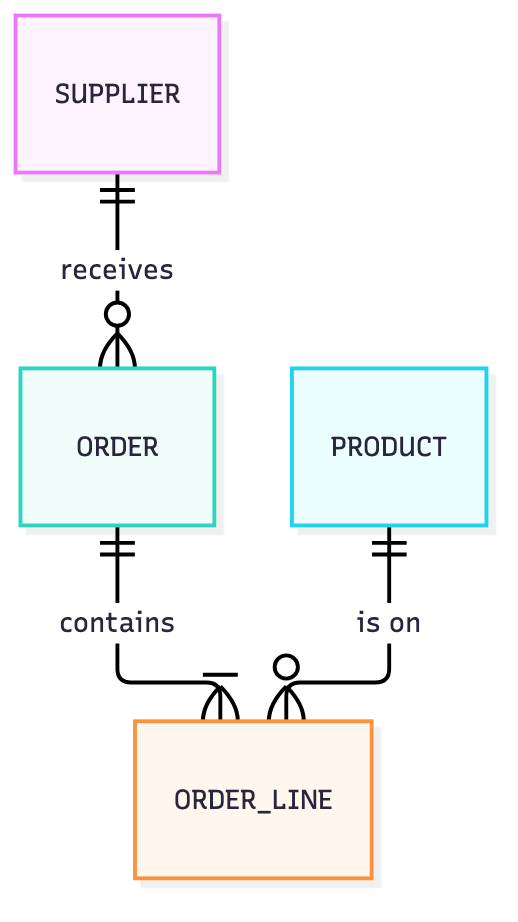

What is read
A block that starts erDiagram is read into the same boxes and links as a flowchart, so everything else on this page holds for it: the rules, the design, Merlive's own lines. An entity is a box that lists its attributes under its name; a relationship is a link that says, at each end, how many.
| Written | Read as |
|---|---|
ORDER, ORDER-LINE, "Purchase order" | An entity: a box. In Merlive's own lines it is named with _ for whatever an id cannot hold (%% note ORDER_LINE: …, %% main: Purchase_order>ORDER_LINE) |
s[Supplier], a["Supplier account"] | An alias, shown in place of the name |
ORDER { … } | Its attributes as a table under its name: a row for each, a column for types, one for names and one for keys when any has a key, ruled into cells with every second row shaded. Declared twice, the two lists are joined |
int number, string(40) reference, string[] barcodes, decimal(10,2) price, date? paid | An attribute: its type, then its name, shown as written |
int number PK, string code PK, FK, string *code | Its keys, after its name. A star before a name is a primary key, and is shown as PK |
string reference "Only 40 characters" | Its comment, kept out of the table so the boxes stay narrow: it is in the note on its entity, after whatever note its author wrote (reference: Only 40 characters) |
SUPPLIER ||--o{ ORDER : receives | A relationship: a link from the first entity to the second, with its words. They may be in quotes, empty, or left out |
||, |o o|, }| |{, }o o{ | How many, at the end it is written at: one; none or one; one or more; any number. Either spelling at either end |
only one, 1, zero or one, one or zero, one or more, one or many, 1+, many(1), zero or more, zero or many, 0+, many(0) | The same, in words |
--, to | A relationship that gives the second entity its identity: a solid line |
.., optionally to | One that does not: a dotted line |
SUPPLIER }o..o| SUPPLIER : "buys from" | A relationship from an entity to itself: a small loop beside it |
subgraph Buying … end, subgraph "Paying up", subgraph pay ["Paying up"], Buying ||--|| Paying : … | A group, one inside another if written so, as in a flowchart; a relationship with a group goes to where it starts or from where it ends |
classDef late stroke:#c62828, class ORDER,INVOICE late, ORDER:::late | Kinds, as in a flowchart. A box is of one kind: of several classes (late,held), the first |
style ORDER stroke:#c00,stroke-width:4px,stroke-dasharray: 5 5 | What the style says of its outline, as in a flowchart |
direction TB | The way it runs. An entity diagram is drawn top to bottom for now: any other direction is read past, and said once. A group's own direction across it is followed, as in a flowchart |
title: in front matter, accTitle, accDescr, %% comments | As in a flowchart |
Not read, each named in a note, line when met: attributes written on the line that opens them (ORDER { int number }), and a line between the braces that is not a type and a name. A name written as Markdown ("A **firm** order") is drawn as plain words.
Feature by feature
Every feature Mermaid’s own pages set out for an entity diagram, each with a sample of it in the corpus. A sample is drawn when every box, link and word it has is read and every rule passes. Drawn, less something is the same with one thing known to be missing, named beside it.
Written from skills/merlive/reference.md in the repository, so the two cannot disagree.