Class diagrams
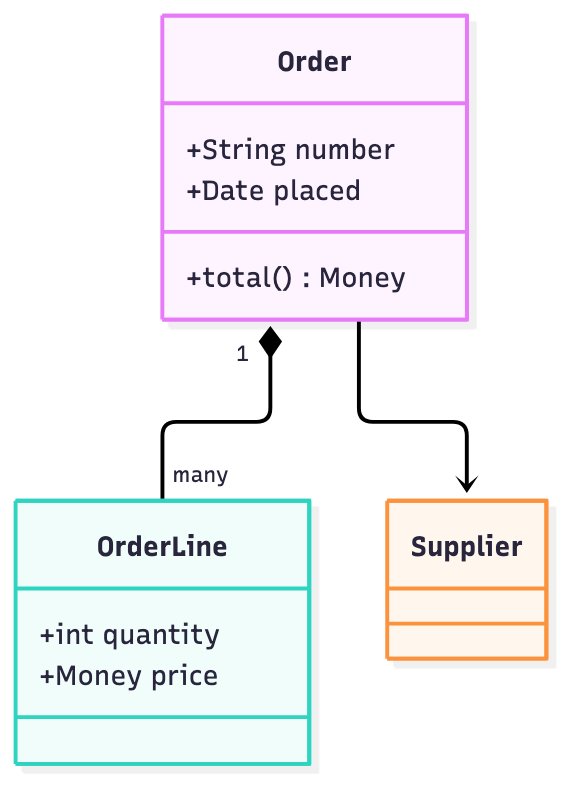
A class is a box that lists its attributes and its methods under its name. Held to the same measure, and to the rows each box lists and what each link ends in.
Declared with classDiagram. Of 36 features Mermaid documents for a class diagram, 28 drawn as written, 8 drawn less something. See all 36 drawn both ways, or draw one yourself.

What is read
classDiagram and classDiagram-v2 are read into the same boxes and links as a flowchart, so everything else on this page holds for them: the rules, the design, Merlive's own lines.
| Written | Read as |
|---|---|
class Order, or a name first met in a relation | A class: a box named by its name |
class Order["A purchase order"], class `Purchase order!` | A class with a label, or with a name no bare name could be. In Merlive's own lines it is the name without the backticks |
class Basket~Item~ | A class called Basket<Item>. What it is generic over is no part of its name: relations and Merlive's own lines say Basket |
Order : +String number, class Order { +String number … } | A member: one row of the box. Rows that end in brackets are what the class does and come second; the rest are what it holds and come first. A class that only holds, or only does, has one compartment |
+, -, #, ~ before a member; total() Money | Kept as written: who may see the member, and what it gives back |
List~Item~, List~List~Item~~ in a member | List<Item>, List<List<Item>> |
check()*, total() Money*, count()$, String prefix$ | The row ends in the words {abstract} or {static} |
class Payable <<interface>>, <<interface>> Payable, <<interface>> inside the brackets | What the class is, over its name: «interface» |
Document <|-- Order, Order --|> Document | Inheritance: a link with a triangle at the parent. It is drawn from the parent down to the child, whichever way it was written |
Payable <|.. Invoice, Invoice ..|> Payable | Realisation: the same, dotted |
Order *-- OrderLine, Warehouse o-- Product | Composition and aggregation: a filled or an open diamond at the class that holds |
Invoice --> Order, Order ..> PriceList | Association and dependency: an arrow, on a solid or a dotted line |
Supplier -- Contact, Buyer .. Note | A link with nothing at either end |
Supplier <--> Buyer, Bundle *--o Product | A relation that says something at both ends |
Order "1" *-- "1..*" OrderLine : holds | How many, beside each end, and the words on the link |
Payable ()-- Invoice, Order --() Printable | A lollipop: a small box of its own for each class that offers it, named for the interface, marked «interface», with a circle on its line. In Merlive's own lines it is Invoice_Payable |
namespace Buying { … }, namespace Auth["Signing in"] { … } | A group of the classes declared in it, called by its label when it has one |
A namespace inside another, namespace Shop.Ordering.Buying { … } | A group inside a group. A dotted name makes every group it spells out, each once, called by its last word; in Merlive's own lines a group is its whole dotted name |
note for Order "words", note "words" | A note drawn on the picture: a sheet with a folded corner, joined to its class by a dotted line, or to nothing. A \n or <br> in it is a new line. It is as tall as its words need |
classDef, cssClass "Order,Invoice" late, Order:::late, style Order … | Kinds and outlines, as in a flowchart |
click, link, callback | Read past |
Not read yet, each named in a note, line when met: a direction other than top to bottom (direction LR), since boxes of different heights are only placed that way for now; a lollipop at both ends of one line. A line that is none of the above is said with its line number and nothing is drawn from it.
Feature by feature
Every feature Mermaid’s own pages set out for a class diagram, each with a sample of it in the corpus. A sample is drawn when every box, link and word it has is read and every rule passes. Drawn, less something is the same with one thing known to be missing, named beside it.
Written from skills/merlive/reference.md in the repository, so the two cannot disagree.